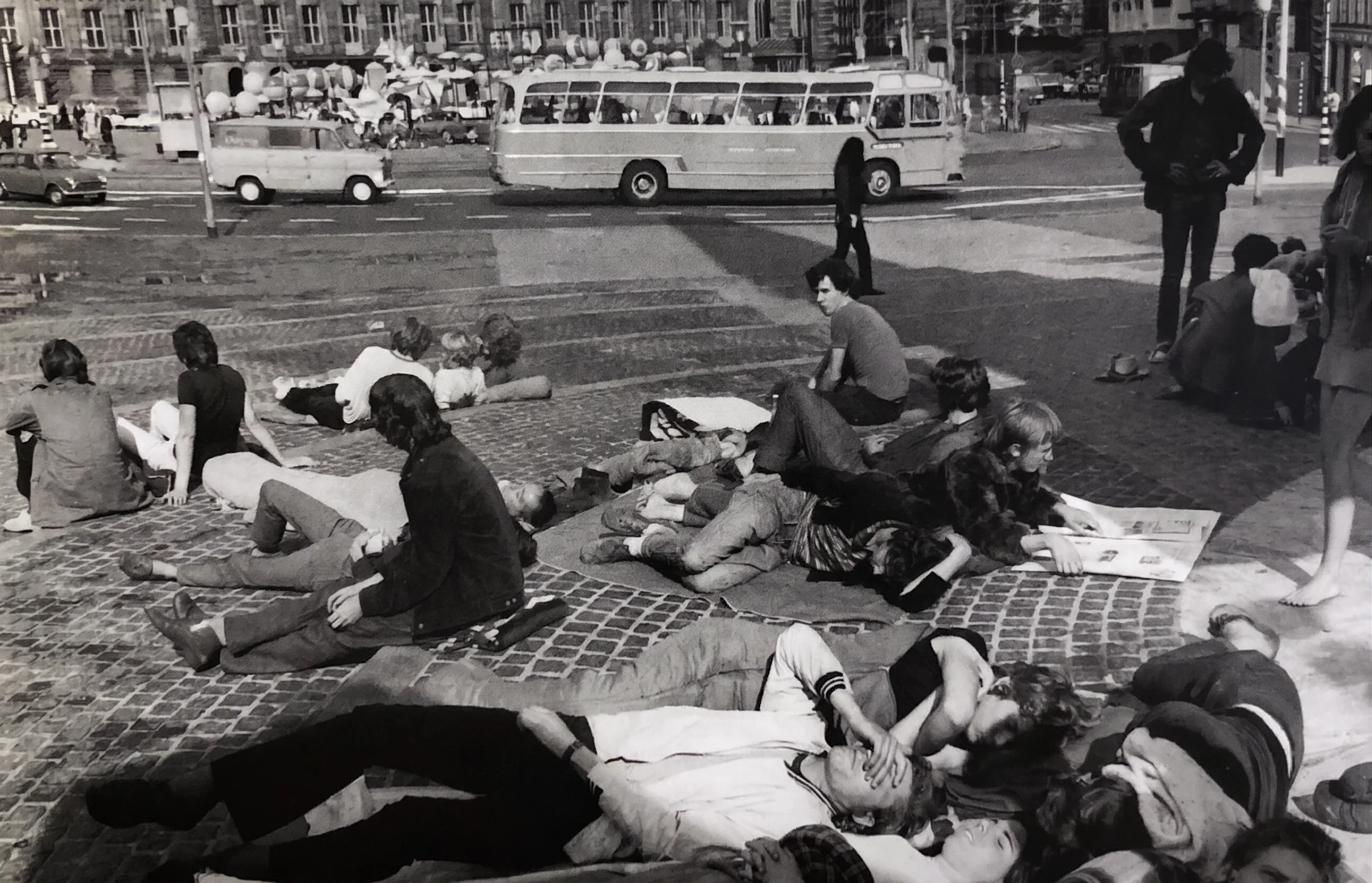
Amsterdam counterculture history usually arrives as a montage: street demonstrations, experimental art, alternative lifestyles, scuffles with authority. The Hare Krishna devotees belong in the picture, but not as a wing of Provo, nor as hippie culture with a religious coat of paint. The better question is how such different groups shared a city, met the same audiences and gave sharply different answers to the same question: how might life be lived?
Provo baited the establishment with a small magazine, happenings and playful breaches of public order. The Amsterdam City Archives keep the third issue of Provo, from September 1965, and record the movement’s actions around the Lieverdje statue and its repeated run-ins with the police. Provo did not last long, yet it shaped how the city remembers the 1960s. The history of Hare Krishna in Amsterdam comes from a later phase and a different religious source; compare the two by all means, but keep the differences in sight. [1]
Prins Hendrikkade 142 is where the story gets an address. Fantasio opened there in March 1968 and turned into Meditation Centre De Kosmos in autumn 1969, with a program of yoga, meditation, mysticism and other cultural or spiritual subjects. Hare Krishna public meetings were held at De Kosmos, according to Amsterdam’s municipal history. Here Amsterdam counterculture history stops being an abstract generation and becomes rooms, lectures, gatherings and people moving from one kind of event to another. [2, 3]
“With Provo, we wanted to change the world. We wanted a society in which people could choose their own lives.” So Provo co-founder Roel van Duijn later recalled, and his words capture one unmistakable thread of the period: challenge authority, widen choice. The Hare Krishna movement offered another structure altogether. It did not treat freedom chiefly as release from inherited convention; it taught a life shaped by scripture, devotional practice and discipline. Some people may have moved between the two worlds, but that has to be shown case by case, not assumed for a whole generation. [4]
Prabhupāda, for his part, questioned whether an education focused on basic material competition could satisfy students; he said as much in a 1973 conversation. His criticism comes from the movement’s own spiritual critique of modern life, not from a detached judgment of Dutch youth culture. Set against the records of Provo, De Kosmos and the street scene, it shows how many ideals were competing for attention. [5]
Good Amsterdam counterculture history refuses to flatten every alternative group into one. Provo, De Kosmos, the hippie networks and the Hare Krishna community shared streets and an era of cultural change, but their values and practices differed.
Provo co-founder Roel van Duijn said: “With Provo, we wanted to change the world. We wanted a society in which people could choose their own lives.” interview with NH Nieuws (2018). [4]
sources & further reading
- Stadsarchief Amsterdam, “Provo.”
- Kosmos Archive, “De Kosmos.”
- Municipality of Amsterdam, “Hare Krishna’s van Amsterdam.”
- NH Nieuws, “Roel van Duijn: ‘Met Provo wilden wij de wereld veranderen’,” 31 January 2018
- A. C. Bhaktivedanta Swami Prabhupāda, “Garden Conversation,” London, 3 August 1973
- Bhagavad-gītā 2.47
Look inside
Browse Chapters Previews
Short previews with videos of the chapters of The Amsterdam Adventure book.