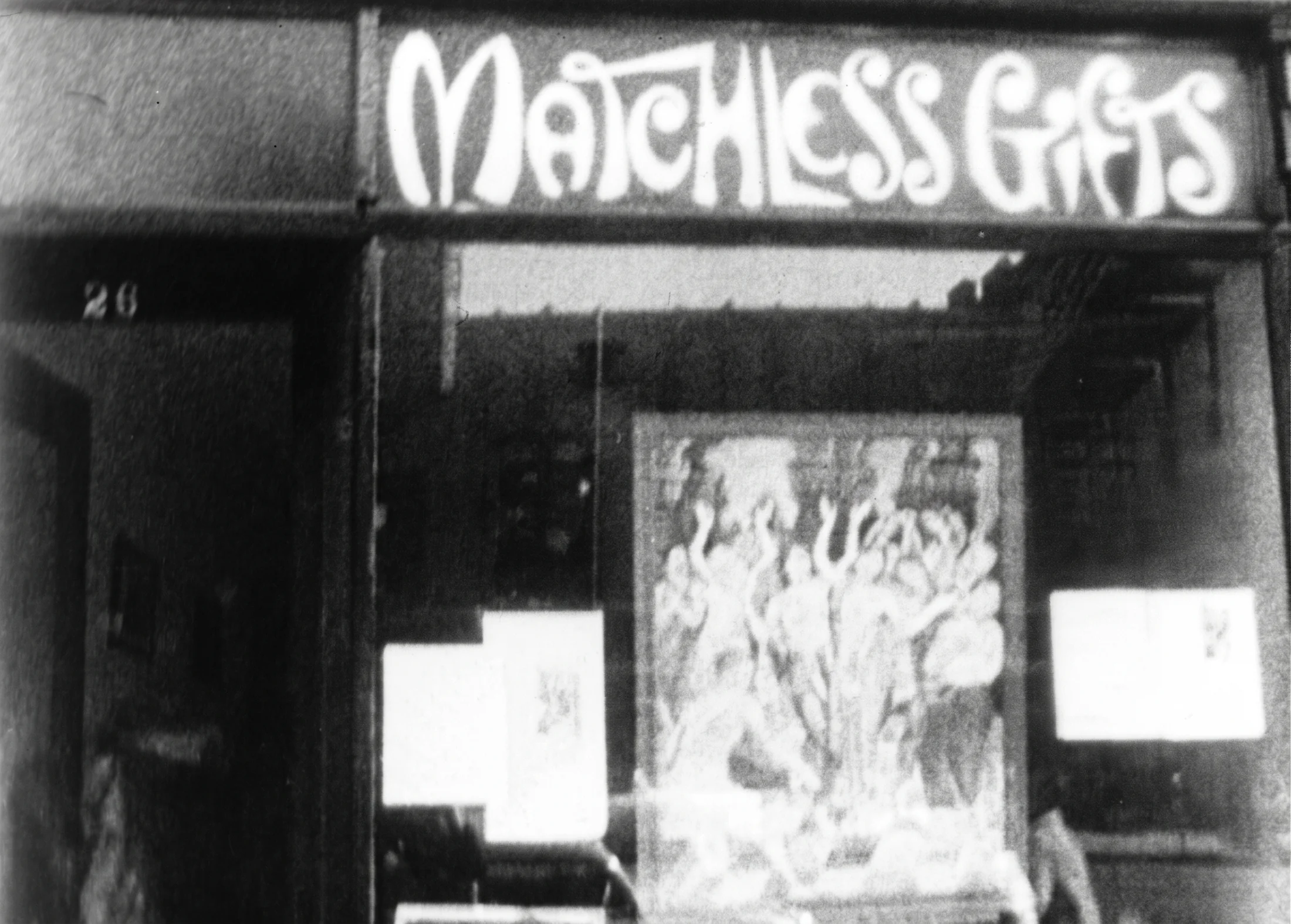
Generous budgets play no part in the early history of Hare Krishna in Amsterdam. The story starts with a few people trying to make a kirtan visible in a city already buzzing with experiments in music, politics, communal living and alternative spirituality. The history of Hare Krishna in Amsterdam thus runs on two tracks at once: the spread of a kirtan through Europe, and the restless cultural life of postwar Amsterdam.
“Krishna desired you to go to Amsterdam, and therefore, you are not admitted in England.”
— Prabhupādas letter to Sivananda, 24 August 1968. [1]
1968 is a good place to begin. A retrospective history of ISKCON in the Benelux identifies Sivananda dāsa, a North American disciple of A. C. Bhaktivedanta Swami Prabhupāda, as an early visitor to the Netherlands. Refused entry to Britain, he made for Amsterdam instead and chanted in public on Dam Square. Prabhupāda’s letter of August 24, 1968, mentions the Amsterdam visit and urges his disciple to keep going with courage and chanting. Seldom is the line between a pioneer and the founder so direct. [1, 2]
The first Dutch Hare Krishna temple opened in 1970 at Bethaniënstraat 39, in a former garage or bicycle-storage space. Nobody would call it an architectural statement, and that is precisely its interest. An ordinary city building was converted for worship and community life; according to a heritage account by Stadsherstel Amsterdam, nine followers lived there in 1971. Institutions, it turns out, begin with the basics: somewhere to sleep, a temple room, a kitchen, daily worship and public chanting. [3]
In 1972 the founder came in person. Amsterdam’s own historical account has Prabhupāda visiting the Bethaniënstraat temple and Vondelpark and giving evening talks at the Krasnapolsky Hotel. For the local devotees it meant meeting the teacher whose books and instructions guided ISKCON across the world. It also showed how the movement reached beyond its own walls: through public lectures, conversations, kīrtana and the distribution of vegetarian food. [4]
In 1973 the community moved its temple to Herengracht 96. Worship now went on behind the façade of a familiar Amsterdam canal house—though saffron robes, shaved heads and public chanting ensured that nobody mistook the residents for ordinary neighbors. Still, the history of Hare Krishna in Amsterdam is more than a change of addresses. Every building opened new possibilities for worship, outreach, shared meals, book distribution and conversation with curious locals. [4]
Context matters. In the 1960s Amsterdam’s Provo movement had needled the establishment with publications, street actions and public happenings. Provo was not ISKCON, and squeezing both into one neat counterculture narrative would distort them. Yet they shared an era in which some residents doubted inherited social habits and experimented with new forms of public life. One line kept in the Amsterdam City Archives defines a riot as an open conflict between provocations from authority and opposition—a fair sample of the charged, theatrical language of the time. [5]
yadā yadā hi dharmasya
glānir bhavati bhārata
abhyutthānam adharmasya
tadātmānaṁ sṛjāmy ahamWhenever and wherever there is a decline in religious practice, O descendant of Bharata, and a predominant rise of irreligion—at that time I descend Myself.
Four milestones give the history of Hare Krishna in Amsterdam its frame: the pioneer’s visit, the Bethaniënstraat temple, Prabhupāda’s 1972 visit and the Herengracht years. Beyond the city the story continues with the founding of Radhadesh in Belgium in 1979. Taken together, these places show a small local community growing into part of a wider Benelux devotional network. [6]
A line from the Provo magazine, preserved by Amsterdam City Archives: “Every riot is the open conflict between the mutual provocations of authority and opposition.”[5]
sources & further reading
- A. C. Bhaktivedanta Swami Prabhupāda, “Letter to Sivananda,” 24 August 1968
- “Benelux History”
- Stadsherstel Amsterdam, “Bethaniënstraat 37–39.”
- Municipality of Amsterdam, “Hare Krishna’s van Amsterdam,” 24 October 2019
- Stadsarchief Amsterdam, “Provo,” including the September 1965 issue record
- Bhagavad-gītā 4.7
Look inside
Browse Chapters Previews
Short previews with videos of the chapters of The Amsterdam Adventure book.