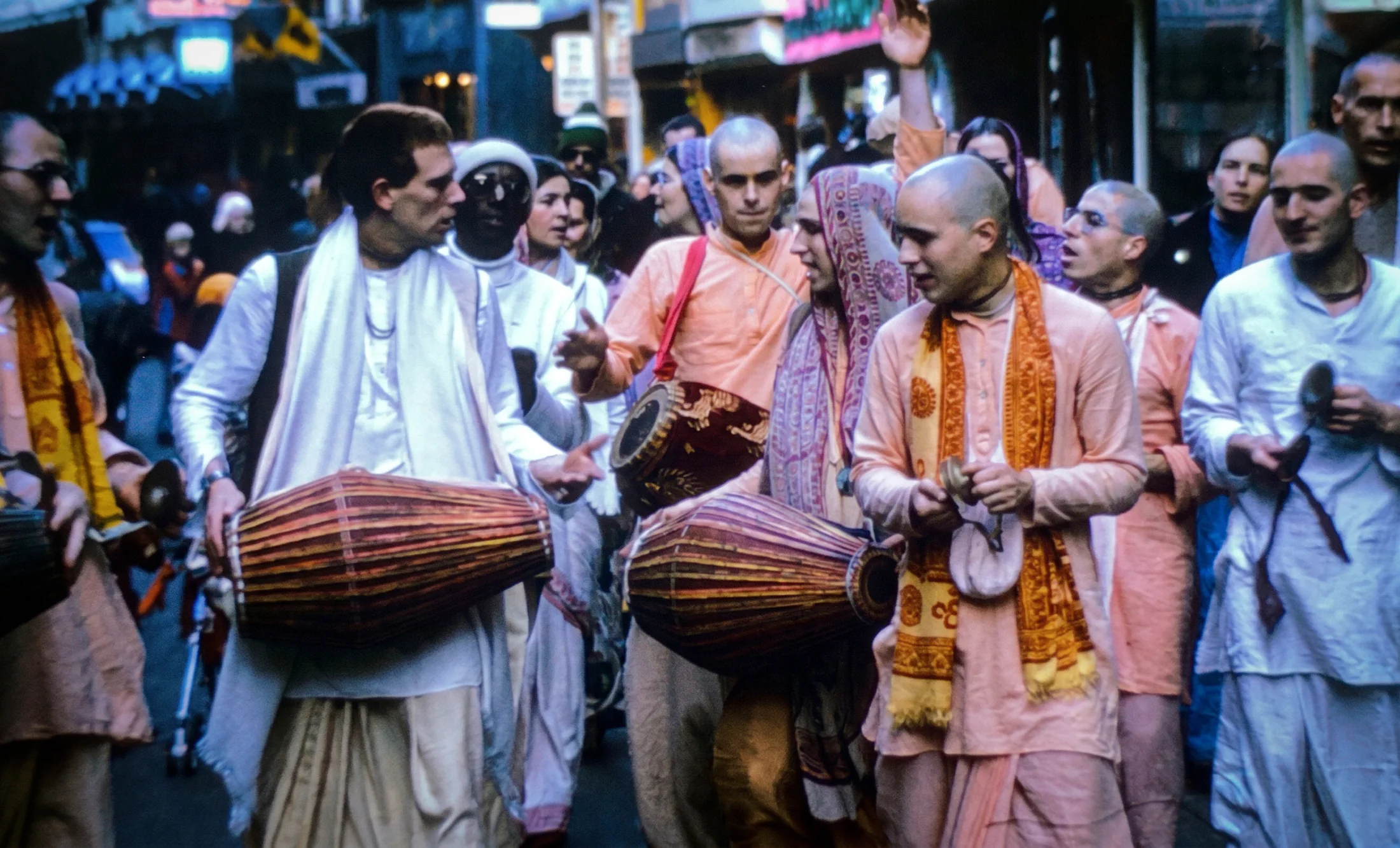
Nobody was waiting for them. The early Hare Krishna devotees in Amsterdam arrived in a city already crowded with street life, quarrels about authority, music, informal meeting places and spiritual experiments. Their own group was small, and it grew on everyday things: a room to live in, food to cook, the knack of talking to strangers, and the habit of coming back the next day to chant again.
“If some of them are curious to learn something, they may purchase one of our books.” — Śrīla Prabhupāda, [4]
Start at Prins Hendrikkade 142. Fantasio opened there in March 1968; by autumn 1969 it had become Meditation Centre De Kosmos, offering courses and lectures on yoga, meditation, mysticism and other spiritual traditions. Amsterdam’s municipal history notes that Hare Krishna devotees held public Sunday meetings there. De Kosmos was never an ISKCON temple. It was more of a crossroads, where the spiritually curious could meet a variety of teachers and traditions side by side. [1, 2]
The first Amsterdam temple was a former garage at Bethaniënstraat 39, opened in 1970; nine followers were living there in 1971, says a heritage account. Small, adapted from an earlier use and never designed for worship, it makes the history unusually easy to read. Before a movement has a lasting public face, it has floors to sleep on, meals to cook, instruments to stow, visitors to greet and routines to keep. [3]
Then, in 1972, Prabhupāda came. The municipal history puts him at the Bethaniënstraat temple, in Vondelpark and at lectures in Hotel Krasnapolsky. Far from a ceremonial stopover, the visit brought a young community face to face with the teacher whose books, recorded talks and instructions gave it a philosophy. Anyone studying the early Hare Krishna devotees in Amsterdam can use it as a fixed point around which to arrange contemporary reports, photographs and later recollections. [2]
Outsiders noticed them too. The same municipal history quotes the writer Harry Mulisch, for whom the followers moved through the city “against the current” in a “slow, swaying goose-step”. The image sticks because it is an outsider’s: robes, shaved heads, rhythm and repetition, all conspicuous on a Dutch street. But it is a literary observation, not reportage, and it does not describe every devotee on every day. [2]
yat karoṣi yad aśnāsi
yaj juhoṣi dadāsi yat
yat tapasyasi kaunteya
tat kuruṣva mad-arpaṇamWhatever you do, whatever you eat, whatever you offer or give away, and whatever austerities you perform – do that, O son of Kuntī, as an offering to Me.
Bhagavad-gītā 9.27
Legend is a poor guide to the early Hare Krishna devotees in Amsterdam; documented places and practices are better. The De Kosmos meetings, the Bethaniënstraat temple, the public chanting and the 1972 visit all leave a trail. Memories add warmth and texture, but they should be tied to named witnesses or manuscript references, so that nostalgia enriches the record instead of replacing it.
Harry Mulisch, Het seksuele bolwerk (1973): “Against the current, Krishna’s followers approached in a slow, swaying swami-step.” [2]
sources & further reading
- Kosmos Archive, “De Kosmos” (Fantasio opened 29 March 1968; centre renamed in autumn 1969)
- Municipality of Amsterdam, “Hare Krishna’s van Amsterdam,” including the Harry Mulisch excerpt
- Stadsherstel Amsterdam, “Bethaniënstraat 37–39.”
- Satsvarūpa dāsa Goswami, *Śrīla Prabhupāda-līlāmṛta*, chapter 40, online edition
- Bhagavad-gītā 9.27
Look inside
Browse Chapters Previews
Short previews with videos of the chapters of The Amsterdam Adventure book.