“Do not be afraid of crossing boundaries; you will not fall off this world for it.”
Simon Vinkenoog, “Rolling Stone” (1972) [3]
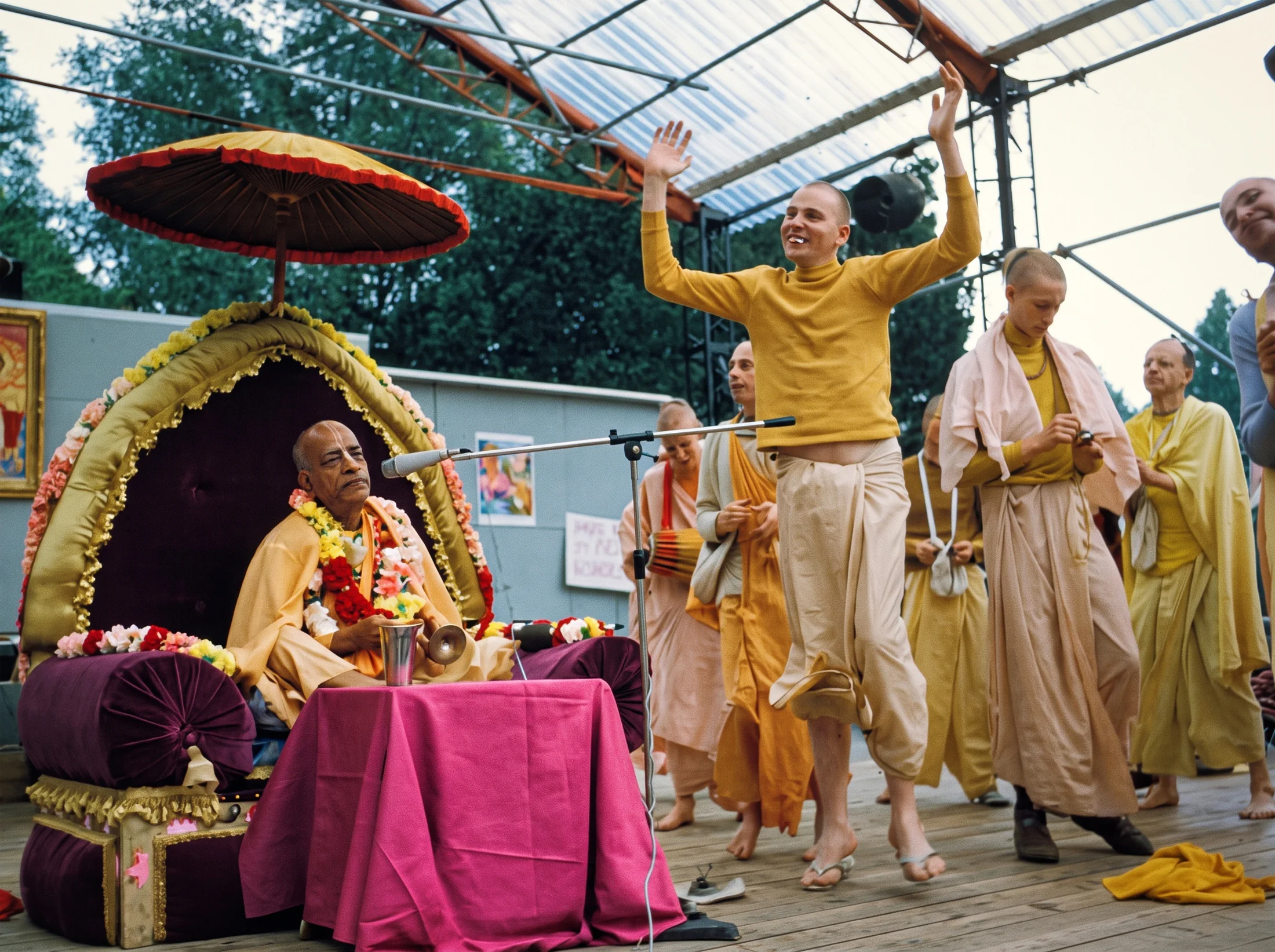
Some went looking for music beyond the mainstream. Others wanted a different way to live, a spiritual practice, or simply somewhere to belong. In early-1970s Amsterdam the search took many forms, and the story of Hare Krishna hippies in Amsterdam is one of them—though not a tale of one scene turning neatly into another. The sound of kirtan drew some, the ideas drew others, the people drew still others; some may have listened once and walked on.
Pop music had already done some of the introductions. George Harrison’s 1970 hit “My Sweet Lord” carried the Hare Krishna mantra far beyond temple circles, and in the early 1970s the London-based Radha Krishna Temple singers went on tour, appearing at Amsterdam’s Concertgebouw. The city’s own history records a small comedy of expectations: the posters had led people to expect Harrison himself, and the singers came without him. Music could open a door; it could also send people through it expecting someone else. [1]
On the street, chanting made bhakti yoga part of the everyday scenery. A procession of devotees with instruments and a repeated mantra resembled neither a church service nor a private meditation class. Anyone already moving through Amsterdam’s alternative networks met here a tradition that was public, rhythmic and communal. Sharing a pavement is not sharing a program, however. The counterculture might question authority, try communal living or explore consciousness; Gauḍīya Vaiṣṇavism came with its own theology, discipline and devotional commitments.
Prabhupāda had his own view of the young. In a letter about outreach he wrote: “The hippies are not bad souls, because soul is part and parcel of Krishna.” The sentence is theology, not sociology—an insistence that every person has spiritual potential, not a survey of everyone labeled a hippie. It also reveals the movement’s approach to outreach: meet people with the possibility of spiritual change in mind. [2]
A Dutch poet caught the mood in a line. Simon Vinkenoog’s urges, in translation: “Do not be afraid of crossing boundaries; you will not fall off this world for it.” [3]
yoginām api sarveṣāṁ
mad-gatenāntar-ātmanā
śraddhāvān bhajate yo māṁ
sa me yukta-tamo mataḥOur translation: “Among all yogīs, the person who serves Me with faith and keeps Me within the heart is, in My view, most deeply united with Me.”
Bhagavad-gītā 6.47
Closing
What makes the story of Hare Krishna hippies in Amsterdam compelling is the gap between curiosity and commitment. Music could catch the ear; a public conversation could lead to study; and in many documented cases a person took up practice of bhakti yoga.
sources & further reading
- Municipality of Amsterdam, “Hare Krishna’s van Amsterdam,” especially the sections on George Harrison and the Concertgebouw tour
- A. C. Bhaktivedanta Swami Prabhupāda, “Letter to Kṛṣṇa dāsa.”
- Simon Vinkenoog, “Rolling Stone” (1972), quoted/referenced in Vrije Universiteit Amsterdam dissertation
- Bhagavad-gītā 6.47
Look inside
Browse Chapters Previews
Short previews with videos of the chapters of The Amsterdam Adventure book.