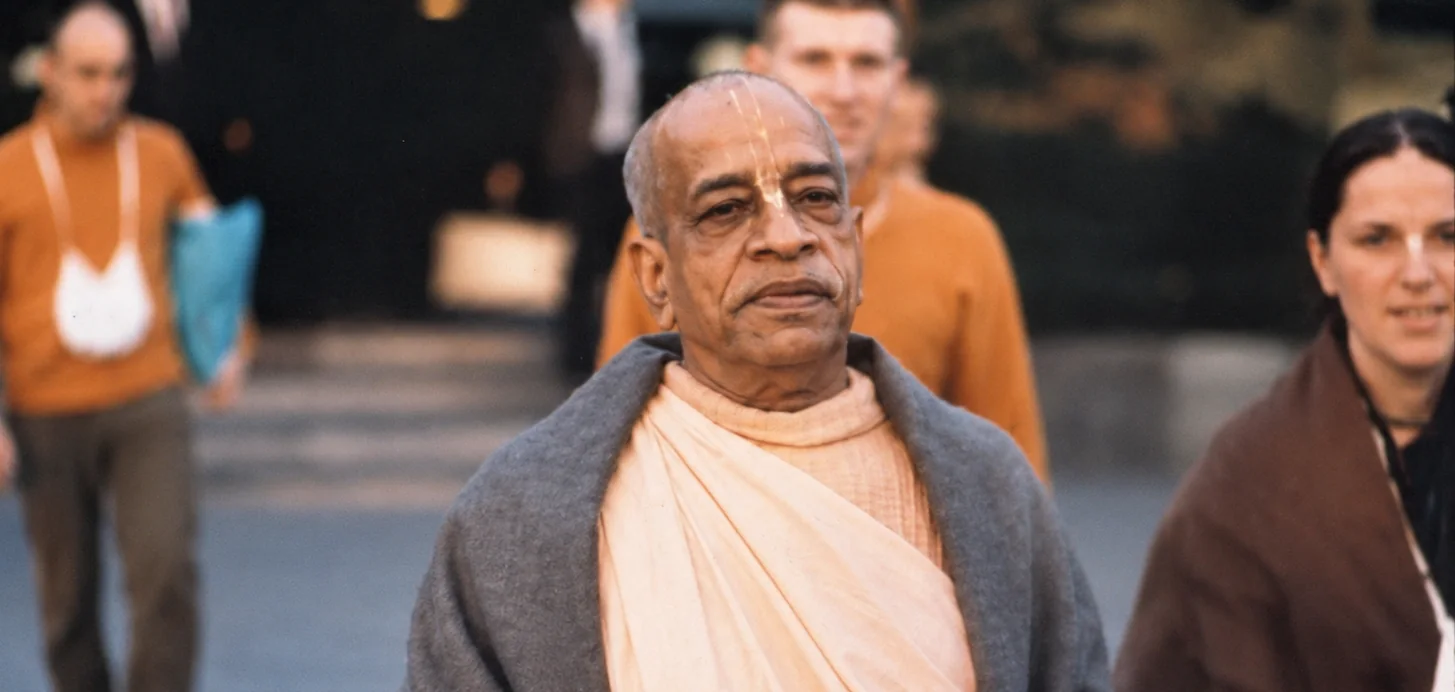
A brahmacārī is a student or celibate practitioner, a sannyāsī has formally entered the renounced order, and grihasthas serve within family life.
“To give up the karma phalaṁ, the result of your work, to Kṛṣṇa—that is real sannyāsa; that is real renunciation.”
— Śrīla Prabhupāda, “Departure Address,” New York, 25 July 1974. [3]
In 1970 a converted garage at Bethaniënstraat 39 became the first Dutch Hare Krishna temple; by 1971, a heritage account records, nine followers lived there. Worship and communal life had to fit into a cramped city space. Public chanting, study of the Bhagavad-gītā, shared meals and the welcoming of visitors were not add-ons. They were temple life, and together they made the community visible in Amsterdam.
“It was an experiment, and we took it on, Renunciation is a conviction of the heart.”
— Kadamba Kanana Swami (Amsterdam)
Renunciation, in the Vaiṣṇava account, is neither a costume change nor a flight from society. What changes is the purpose of one’s work. Prabhupāda described sannyāsa as giving the fruits of one’s work to Krishna. Practical duties survive intact—meals still have to be cooked, a temple kept up, books published, visitors cared for—but they take their place within a particular spiritual purpose. [3]
What should compassion look like? The Bhagavad-gītā answers with a portrait of the person dear to Krishna: free from hatred, friendly and compassionate toward all beings, steady in happiness and distress, forgiving. It is a theological ideal, not proof that every practitioner always matched it. Good history records both the ideals people professed and the very human effort of living by them.
adveṣṭā sarva-bhūtānāṁ
maitraḥ karuṇa eva ca
nirmamo nirahaṅkāraḥ
sama-duḥkha-sukhaḥ kṣamī“One who bears no hatred, is friendly and compassionate, free from possessiveness and false ego, steady in joy and distress, and forgiving is very dear to Me.”
Bhagavad-gītā 12.13
The history of Krishna monks in Amsterdam has room for both belief and complexity. Temple routine, celibacy, renunciation, study and outreach make sense when explained in the tradition’s own terms and anchored in documented experience.
sources & further reading
Look inside
Browse Chapters Previews
Short previews with videos of the chapters of The Amsterdam Adventure book.